Branded Residences Explained· Ultimate GuideFeatured

What exactly is a branded residence? The definitive 2026 guide

The complete pillar guide to branded residences — what they are, how the three-party model works, what you actually own, how the branded premium behaves at resale, and how to read the emerging Delhi NCR market.

Aarav Mehta· 24 min read· Updated 14 July 2026
What exactly is a branded residence? The definitive 2026 guide
On this page

A branded residence is a privately owned home operated to the service standards of an established hospitality, fashion or design house. You hold title to the apartment outright, but the building — and much of the daily experience of living in it — is run to a codified brand standard, funded collectively by owners and audited by the brand itself. Globally the category has grown from roughly one hundred schemes in the early 2000s to more than seven hundred and fifty completed or announced projects today, and Delhi NCR is now one of the fastest-growing branded markets in Asia, with landmark launches from The Ritz-Carlton, St. Regis, Trump, Tonino Lamborghini, ELIE SAAB, Jacob & Co. and Westin arriving between 2024 and 2028.

This guide is written for the serious buyer. It explains the branded model in plain language, sets out what you actually own versus what is serviced, walks through the history and economics of the category, compares branded residences with conventional luxury apartments and standalone hotels, and shows how to read Gurgaon and Noida specifically — where the branded premium comes from, where it does not, and which projects, developers and corridors are shaping the next decade of the market.

§The definition, decoded

That definition has four moving parts, and each of them matters. First, private ownership: your title is identical to any premium apartment. Second, freehold or long-lease: you can sell, gift, bequeath or let the home just as you would a conventional home. Third, codified standards: the brand does not decorate a lobby and leave — it publishes standard operating procedures, trains staff, and audits the property against its global rulebook. Fourth, a licensed operating agreement: the developer or a resident-owned association pays the brand a licence fee and, usually, a hospitality operator manages the day-to-day service on the brand's behalf.

The reason this matters is because the phrase 'branded residence' is now used loosely by marketers to describe any luxury development with a co-branded lifestyle proposition. A real branded residence sits inside a contractual chain that begins with the brand licensor and ends with the concierge who greets you at the door. If that chain does not exist, what you are buying is a well-marketed apartment — not a branded home.

§Who is involved: the three-party structure

Every genuine branded residence is a triangle. Understanding each party's role — and each party's incentives — is the single most useful thing a first-time buyer can learn about the category.

The brand

The brand is the licensor. It owns the trademark, the service standard and the reputation. In hospitality that means groups such as Marriott International (Ritz-Carlton, St. Regis, Westin, JW Marriott), Accor (Raffles, Fairmont, Sofitel), Four Seasons, Hilton (Waldorf Astoria, LXR), IHG (Six Senses, Regent) and Rosewood. In fashion and design it means houses such as ELIE SAAB, Bulgari, Armani/Casa, Baccarat, Missoni, Tonino Lamborghini, Karl Lagerfeld and Jacob & Co. The brand does not usually own the land, build the building or sell the apartments. It licenses its name, approves the design, trains the operating team and audits the property against its rulebook. The licence fee is typically a share of sales revenue at launch and a share of service charges or operating revenue thereafter.

The developer

The developer is the counterparty on the ground. It secures the land, funds the construction, and delivers the physical asset to the brand's specification. In Delhi NCR this is a maturing group of listed and closely-held names: DLF, M3M, Oberoi Realty, Trump-partnered Tribeca Developers, Smartworld, TARC, Ireo, and — through hospitality tie-ups — Godrej Properties, Signature Global and Elan. The developer signs the operating agreement with the brand, delivers the residences to buyers on freehold or long-lease title, and typically hands the ongoing operation over to a resident-owned association or a professional operator once occupancy is established.

The owner

You are the third party. As an owner you hold registered title to your unit and an undivided share of the common areas. You pay the recurring service charge that funds the branded operation. You inherit a vote — usually through an owners' association — on operational matters that fall outside the brand's protected service standards. And, critically, you own an asset whose resale value is partly a function of how well the brand and the developer honour their side of the triangle over the next twenty to fifty years.

750+
Branded schemes globally
Completed or announced, up from ~100 in 2005
25–35%
Typical price premium
Over comparable non-branded homes
20–50 yr
Brand licence term
Renewable, with performance conditions
12+
Announced schemes in NCR
Gurgaon and Noida, 2024–2028

§What you own versus what is serviced

This is the single most misunderstood aspect of the category, and it is the source of most avoidable buyer anxiety. Your ownership of the home is not affected by the branding. The brand does not co-own your apartment, cannot restrict its sale in normal circumstances, and does not sit on your title. Everything the brand does sits on top of your ownership, funded collectively.

The easiest way to picture this is as two layers. The ownership layer is your registered title, exactly as with a premium non-branded apartment: freehold or long-lease, transferable, mortgageable, inheritable. The service layer sits above the title and covers the branded common experience: concierge, housekeeping to brand standard, security protocols, amenity operation, staff training, brand-audited standard operating procedures and, in many schemes, optional in-residence services you pay for by usage. If the brand ever walked away, your title would remain intact and you would continue to own the home. What would disappear is the serviced layer — and, in a well-structured scheme, the owners' association would have contractual rights to appoint a replacement operator.

Ownership layerBranded service layer
What it coversYour apartment, share of common areas, parking, storageConcierge, housekeeping, amenity operation, staff training, brand audit
How it is paid forOne-time purchase priceMonthly or quarterly service charge and sinking fund contribution
Who holds itYou (registered title)Owners' association, operated by brand-appointed operator
TransferableYes — sale, gift, bequest, mortgagePasses automatically to next owner with the unit
What happens if the brand exitsUnaffectedAssociation appoints a replacement operator under the agreement
Ownership layer vs branded service layer — what you own and what you fund.

§How the branded model actually works

The mechanics are easier to grasp when you follow the money. The developer pays the brand an initial licence fee, typically calculated as a percentage of gross sales revenue and paid in tranches as apartments are sold. The developer also invests in built quality that meets the brand's design and engineering rulebook — often 10 to 20 percent above the specification of a comparable non-branded project. At handover, ongoing operation transfers to a hospitality operator retained by the developer or the owners' association, and this operator is paid through the service charge that owners fund collectively. The brand itself receives a continuing royalty and, in return, keeps the property inside its global reservation, loyalty and audit systems.

For the buyer, the practical consequence is a level of consistency that is almost impossible to sustain in an owner-managed apartment complex. Because the brand's own reputation is on the line, standards are documented, staff are trained to a common curriculum, and slippage triggers audit action. This is the real, durable value of the branded model — not the logo on the door, but the machinery behind it.

§A short history of branded residences

  1. 1927
    The Sherry-Netherland, New York

    Often cited as the earliest true branded residence, combining private ownership with hotel-grade service in Midtown Manhattan.

  2. 1980s
    Ritz-Carlton and Four Seasons pioneer the modern model

    Hotel groups extend their brand and operating standards to private residences in the United States, formalising the licence-plus-operate structure now used worldwide.

  3. 2000s
    Fashion houses enter the category

    Armani, Bulgari, Versace and Missoni launch branded residences, opening the door for design-led non-hospitality brands.

  4. 2010–2020
    Global expansion

    Branded pipeline grows from roughly one hundred schemes to over four hundred, with hubs in London, New York, Miami, Dubai, Bangkok and Singapore.

  5. 2020–2024
    India's first wave

    Trump Towers Gurgaon, Trump Towers Pune, Four Seasons Private Residences Mumbai and early Marriott-branded schemes establish proof of concept.

  6. 2024–2028
    Delhi NCR's branded launch cycle

    Ritz-Carlton, St. Regis, Westin, Tonino Lamborghini, ELIE SAAB, Jacob & Co. and Trump Residences launch across Gurgaon's Golf Course Extension Road, Dwarka Expressway and Noida's Expressway corridor.

§Why branded residences exist: the value proposition

The category exists because three sets of interests align. Buyers want the reassurance and the resale liquidity that a codified standard provides. Developers want a differentiator that supports pricing, accelerates absorption and de-risks large luxury projects. Brands want a capital-light way to extend their footprint and monetise their trademarks in real estate without building or owning the underlying asset. Each party gets something the others cannot supply on their own, which is why the model has proven durable across three decades and multiple economic cycles.

For the individual buyer, the value proposition compresses into four things: a consistent service standard that ordinary apartment complexes cannot sustain; a level of built quality that is usually higher than comparable non-branded homes because it must clear the brand's engineering rulebook; a smaller and more curated resident community that is self-selecting on lifestyle; and a resale narrative that materially reduces the cost and time of exit when you eventually sell.

The brand protects the downside. The location drives the upside. Serious buyers weigh both.Advisory principle

§Branded residences vs conventional luxury apartments

The clearest way to see what you gain — and what you give up — is to line the two categories up side by side. A conventional luxury apartment can absolutely match a branded residence on address, view and specification. What it usually cannot match is the codified service standard, the brand-audited operation and the resale narrative that follows from both.

Branded residenceLuxury apartment
TitleFreehold / long-leaseFreehold / long-lease
Service standardCodified, audited, brand-trained staffSet by RWA or operator; variable over time
Build specificationMeets brand engineering rulebookDeveloper's specification
Common chargesHigher — funds branded operationLower — market service level
Resale premiumTypically 25–35% over comparable non-branded homesBaseline for the same corridor
Exit liquidityNarrower buyer pool, but branded narrative shortens the saleBroader pool, but no differentiator
Rental yieldSlightly lower gross yield; more resilient tenant profileSlightly higher gross yield; more turnover
Branded residence vs conventional luxury apartment — the practical differences.

§The Delhi NCR branded residences landscape

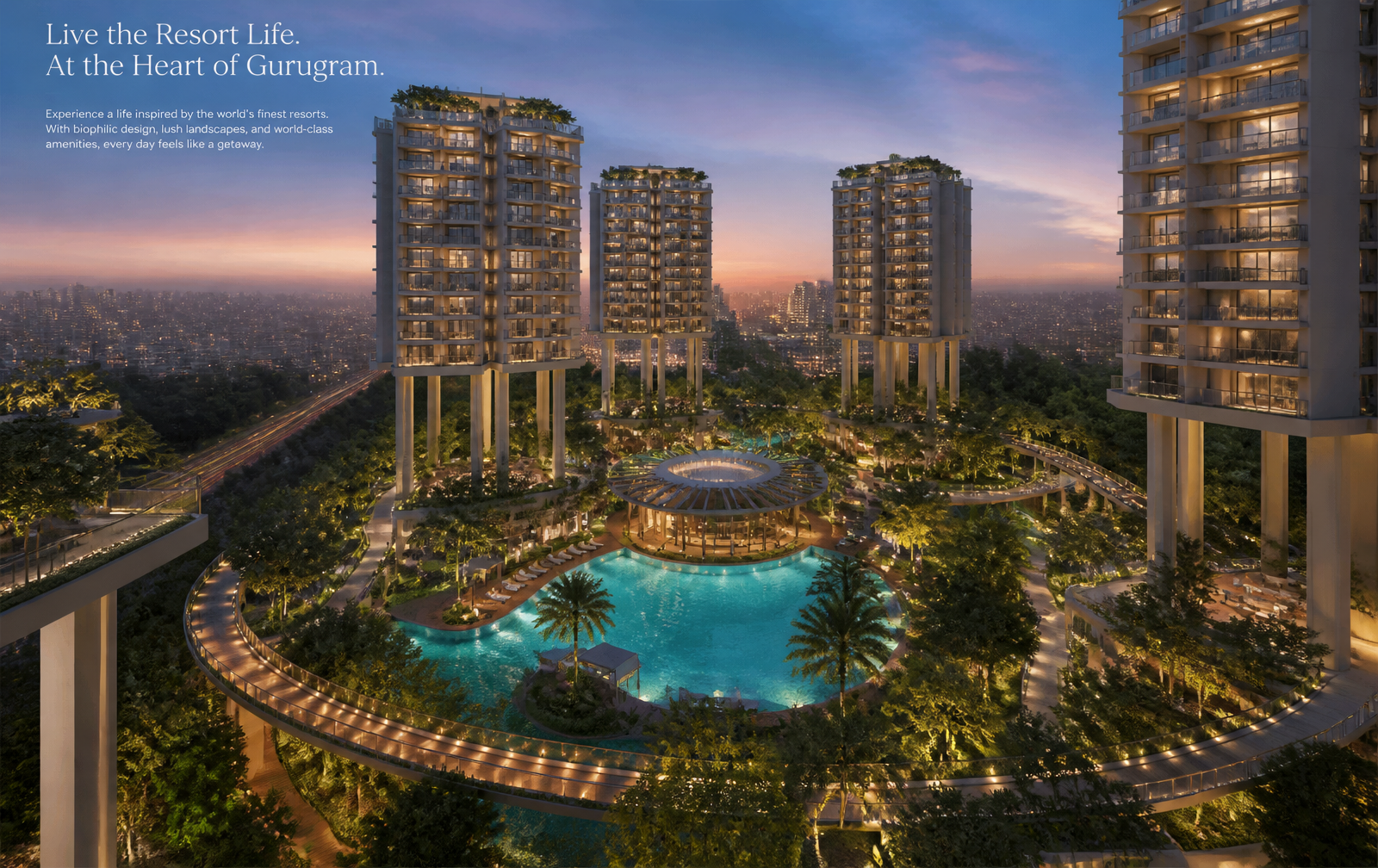
Delhi NCR has moved from a market with a handful of hospitality-linked residences to one of the most active branded pipelines in Asia. The story is concentrated along four corridors: Golf Course Road and Golf Course Extension Road in central Gurgaon; the Dwarka Expressway to the north-west of the city; the Southern Peripheral Road as it feeds into Sohna; and the Noida Expressway through Sectors 94, 96, 97 and 150. Each corridor has a distinct investment character.

Golf Course Extension Road has become the address for hospitality-branded launches, anchored by Trump Residences on Sector 65 and the Tonino Lamborghini Residences in Sector 71. The Dwarka Expressway hosts the world's largest Westin Residences in Sector 103 and the Ritz-Carlton-associated schemes moving into Sector 103–113. Noida Expressway is the growth story, with M3M Jacob & Co. Residences in Sector 97 and Smartworld Residences by ELIE SAAB in Sector 98 anchoring a corridor that until recently had no branded stock. Oberoi Realty's Three Sixty North in Sector 58 marks the entry of Mumbai's most respected luxury developer into the Delhi NCR branded space, on Golf Course Road itself.

The market is early enough that corridor still matters more than brand. A world-class brand on a corridor that has not yet matured will underperform a strong regional developer on Golf Course Road. That is likely to change as the pipeline delivers over the next four years, but for buyers making decisions today, corridor selection remains the primary lever.

§Pros and cons for the buyer

Advantages
  • Documented service standard maintained over decades, not just at launch.
  • Higher built quality driven by brand engineering rulebook.
  • Curated resident profile and stronger community amenity mix.
  • Resale narrative that reduces time-to-sale and negotiation friction.
  • Optional in-residence hospitality services on demand.
  • Protection of the asset through professional operation and sinking fund discipline.
Considerations
  • Higher monthly service charges than a comparable non-branded apartment.
  • Narrower buyer pool at resale, especially in early-stage markets.
  • Rental yields slightly lower than the corridor's non-branded average.
  • Dependence on the continuity of the operating agreement.
  • Smaller unit inventory per scheme, reducing supply-side flexibility.
  • Requires more careful due diligence on the operating structure at purchase.

§Who should buy — and who should not

Branded residences reward a specific kind of buyer. They are strong choices for end-users who value a codified service standard and are willing to fund it, for NRI buyers who want a home in India that will be looked after in their absence, and for long-hold investors who prioritise capital protection and exit liquidity over gross rental yield. They are also well suited to family offices seeking a low-management primary or secondary residence in a maturing luxury market.

They are less well suited to short-hold flippers, yield-first investors optimising for gross rent, or buyers who need a large floor plate at the lowest possible per-square-foot cost. The branded premium is a long-hold instrument. If the intended hold period is under four years, the transaction costs and the service charge premium will usually not be recovered by the branded uplift alone.

§Common misconceptions

  • "The brand owns the building." It does not. The brand licenses its name and audits operation; owners hold title.
  • "You have to use the hotel's services." You do not. In-residence services beyond the base standard are optional and paid by usage.
  • "The brand can force you to sell." It cannot. Ordinary resale rights are the same as any freehold apartment.
  • "Branded means expensive maintenance forever." Charges are higher than a normal apartment, but they are transparent, budgeted and audited — not open-ended.
  • "If the brand leaves, my apartment loses its value." A well-drafted agreement provides for operator replacement; the ownership layer is unaffected.
  • "Every luxury project with a name is a branded residence." Only projects with a licensed operating agreement and codified service standard qualify.

§The future of branded residences in India

Three trends will shape the next decade. First, India will become one of the top five global branded markets by pipeline volume, driven by Delhi NCR, Mumbai, Bengaluru and Goa. Second, the mix will diversify beyond hospitality: fashion, watchmaking, automotive and design brands will account for a rising share of new launches, as ELIE SAAB, Tonino Lamborghini and Jacob & Co. have already demonstrated in NCR. Third, the buyer pool will professionalise. First-generation branded buyers in India have often been end-users; the second wave is increasingly NRI, family-office and long-hold institutional, which will deepen resale liquidity and compress the branded premium's volatility.

For NCR specifically, the next milestones are the delivery of the current 2024–2028 pipeline, the arrival of the first purpose-built branded rental products, and the tightening of RERA-level disclosure around operating agreements. Buyers who position now — while corridor selection still dominates brand selection — are likely to see the strongest total returns.

§Expert perspective

Branded residences are not a product category. They are an operating model. Buyers who understand the model buy well; buyers who buy the logo often overpay.Aarav Mehta, Senior Advisor, Delhi NCR

In practice this means every buyer conversation should start with the operating agreement, not the brand. Ask to see the licence term, the renewal conditions, the service standard schedule, the audit mechanism, and the operator replacement clause. If a developer cannot produce those documents, the branding claim is likely marketing rather than a contractual reality.

Speak to an advisor

Want tailored guidance on this topic?

Our advisors help serious buyers weigh options without pressure — verified numbers, private inventory, no sales calls.

Share

Frequently asked

Aarav Mehta
Senior Advisor, Delhi NCR
Last reviewed 14 July 2026
Explore further

Related residences

Considering one of these residences?

Get verified pricing and a private site visit.

Current price list, availability and a walk-through with a specialist — arranged confidentially.

Continue reading

Related reading

The Briefing

Considered insight on branded residences, occasionally.

Market notes, new launches and buying guidance for Delhi NCR — no noise, unsubscribe any time.