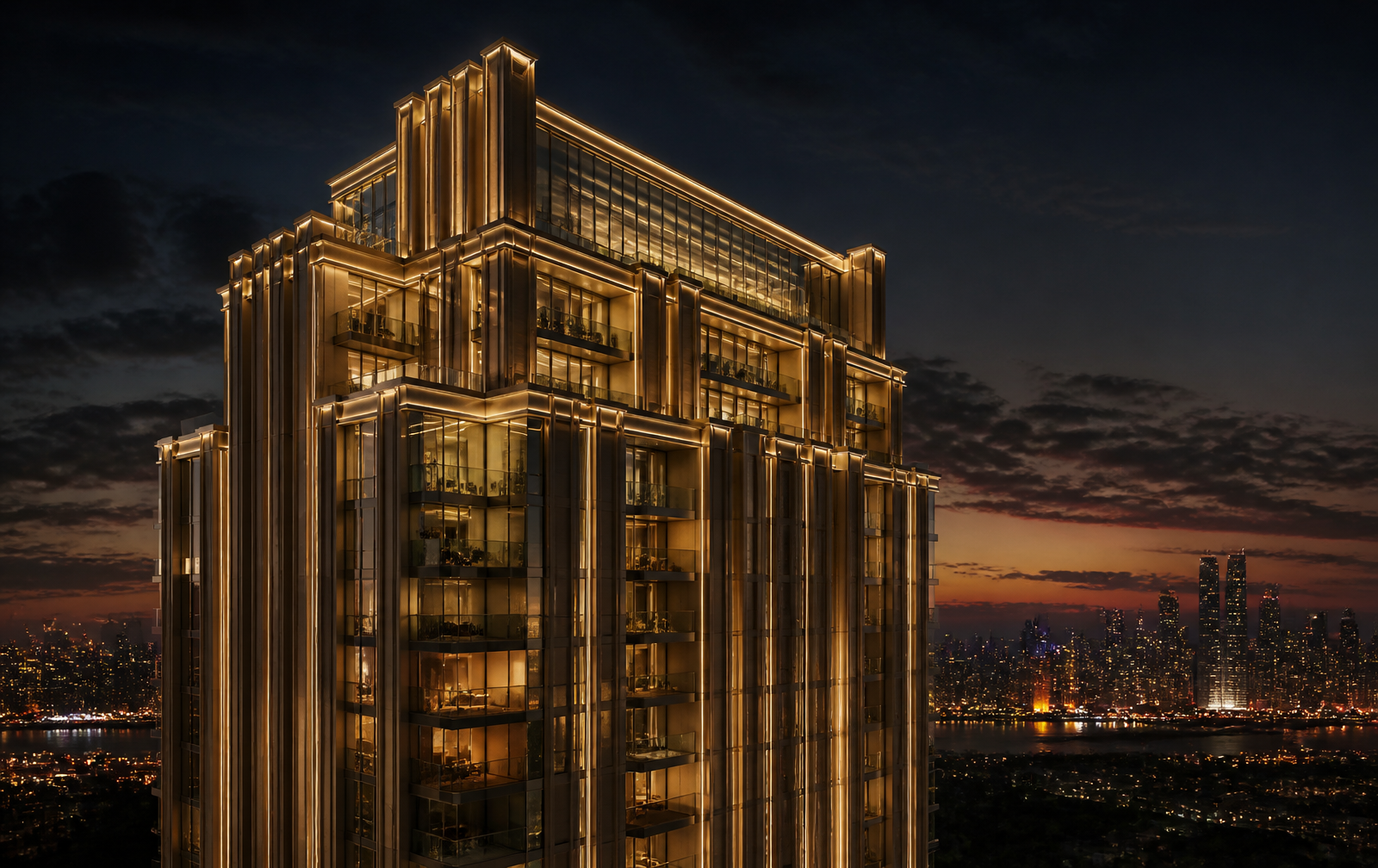
The phrases 'branded residence' and 'serviced apartment' are used interchangeably in luxury brochures, and by the time a buyer sits down with a contract the difference has usually become a source of confusion. It matters, because the two products sit on opposite sides of a fundamental line: one is an asset you own, the other is a room you rent. Everything downstream — pricing, taxation, resale, day-to-day experience, staffing, even how the building is designed — flows from that single distinction.
This guide sets out the differences in plain language, using the Delhi NCR market as the reference frame. It is written for buyers who are seriously evaluating a branded scheme in Gurgaon or Noida but keep encountering marketing that borrows serviced-apartment language, and for corporate housing buyers who are trying to decide whether the branded route is a better use of capital than a long-lease serviced arrangement.
§Two categories, two definitions
The confusion arises because the two products often look identical from the inside of the lobby. Both use a uniformed doorman, a concierge desk, a lift lobby with brand signage, corridors with housekeeping trolleys and a residential-scale amenity floor. But the paperwork on the way in — a sale deed and operating agreement in one case, a booking form or licence agreement in the other — is different in kind, not degree.
§The ownership boundary is the whole story
In a branded residence you sign a sale deed, register title at the sub-registrar's office, pay stamp duty and GST as applicable, take a home loan if you wish, and hold an asset you can gift, bequeath, mortgage or sell. The branded layer sits on top of your title through an operating agreement to which you accede when you buy. Your name is on the title, not the operator's. If the operator changes, your title does not.
In a serviced apartment you sign a booking, a licence agreement or a corporate housing contract. The unit belongs to the operator or to a landlord who has leased the building to the operator. Your interest is a right to occupy for the contract term — one night, one month, one year. There is no title, no stamp duty, no registration, no mutation. When your term ends, your relationship with the unit ends.
| Branded residence | Serviced apartment | |
|---|---|---|
| Legal interest | Registered title (freehold or long-lease) | Licence to occupy for stated term |
| Duration | Perpetual / long-lease (99+ yrs) | 1 night to 24 months typically |
| Primary cost | Purchase price + stamp duty + GST | Nightly / monthly rate, all-in |
| Recurring cost | Service charge + property tax | None separately — bundled into rate |
| Capital growth | Yours — as with any freehold home | None accrues to the occupant |
| Financing | Home loan eligible, up to ~75% LTV | Not applicable |
| Inheritance | Passes to heirs by will or succession law | Terminates on contract expiry |
| Tax on income | Rental income taxed as income from house property | Not applicable to occupant |
| Exit | Sale of unit, or lease-out | Check-out; no further liability |
| Customisation | Interior fit-out permitted within house rules | Not permitted — operator standard |
§Who runs the building and how they earn
A branded residence is operated by a brand-appointed operator under a licence granted by the brand. The operator's contract is with the resident-owned association (or, before the association forms, with the developer). Their fee is a management fee — a percentage of the service-charge budget, typically 8–12% — plus, in some structures, an incentive tied to owner satisfaction and audit scores. They do not take rent from you and do not earn from occupancy; they earn from operating a service platform on behalf of owners.
A serviced apartment is operated by a hospitality company that earns from you directly. Their revenue is the daily rate you pay, less the cost of running the unit. They are optimising occupancy and average daily rate, exactly as a hotel does. The building may belong to a real estate fund, a HNI landlord or the operator itself; the economics are hospitality economics, not residential economics.
§How the money moves
A branded residence has a large upfront cost — the purchase price, stamp duty, GST on under-construction sales, registration, and fit-out where applicable — and a recurring cost that is smaller but predictable: service charges (typically ₹25–55 per sq ft per month in Delhi NCR branded schemes), a sinking-fund contribution, property tax and, if let, income tax on rental. Over a ten-year hold, purchase and stamp duty dominate the total outlay; service charges compound quietly but rarely change the arithmetic of the investment.
A serviced apartment reverses the profile. There is no capital outlay. The recurring cost is the all-in rate — in central Gurgaon that is roughly ₹8,000–25,000 per night for a one-to-three-bedroom unit, or ₹1.5–6.5 lakh per month at long-stay contracted rates for a comparable size. Nothing accrues to the occupant at the end. For a 24-month stay in a three-bedroom branded-quality serviced apartment, a household will typically pay ₹80 lakh–1.5 crore in occupancy costs and hold zero asset at the end.
§The daily experience
Both categories deliver hospitality-grade service. In a well-run branded residence you have a doorman, valet, concierge, housekeeping to brand standard, amenity staff, a residents-only lounge and, in the larger schemes, an all-day dining outlet or partnership arrangement. Housekeeping is usually included in the service charge on a set schedule; deep cleans, laundry, in-residence dining and staffing are billed by usage. The building runs to the brand's SOP and is audited against it.
In a serviced apartment, housekeeping is typically daily or every other day and is fully bundled into the rate. Reception is 24-hour. Breakfast is usually included; other meals are billed. Business services (meeting rooms, printing, IT) are typically stronger than in a residential product because the audience is skewed toward corporate travellers. Amenity is usually more compact — a gym, a pool, a lounge — because the building is smaller and geared to shorter stays.
§Which one suits which buyer
- **Permanent base in Delhi NCR** — buy a branded residence. The premium price is offset by capital growth, mortgage deductibility, inheritance and the fact that the service charge replaces most of what you would otherwise pay to a home-management company.
- **12–36 month posting** — take a serviced apartment. Committing capital to a home you will exit inside three years exposes you to transaction friction (stamp duty, GST, brokerage) that a rental avoids entirely.
- **Second home for 90–120 nights a year** — a branded residence is usually the right answer if you want a permanent Delhi NCR presence and can rent the unit for the remaining months. If usage is genuinely occasional and irregular, a hotel-style residence programme or a serviced apartment on retainer may be cheaper.
- **Corporate housing budget** — serviced apartments are the default. A branded residence only makes sense if the corporate is investing on its balance sheet as a long-term dedicated residence.
- **Wealth preservation** — a branded residence is an asset class; a serviced apartment is an expense. Only one belongs on a balance sheet.
§The hybrid models to watch for
Two hybrid structures blur the boundary and are worth understanding. First, the rental-pool branded residence: you buy a unit but contract it back to the operator to place into a hospitality inventory, splitting revenue. You retain title, but for the days your unit is in the pool it functions as a serviced apartment. These schemes are common in resort markets and rare in Delhi NCR. Second, the fractional or hotel-condominium model: you own a share of a unit or a specified number of nights per year, and the rest of the calendar sits in the operator's hospitality inventory. This is not the same as a branded residence in the pillar sense used in this guide — the ownership share is smaller and the resale market is thinner.
§Delhi NCR context
Serviced apartments in NCR are concentrated in DLF Cyber City (Oakwood, Ascott, Somerset), central Gurgaon (Hyatt Regency Residence Suites, The Leela Residences), Aerocity (Roseate) and South Delhi. They serve the expatriate and senior corporate audience that arrives on 6–36 month postings. Rates have risen roughly 30–40% since 2022 as expat inflows returned and corporate travel policies normalised.
Branded residences are a different market. Marquee schemes announced or under construction include The Ritz-Carlton Residences (DLF, Golf Course Road), St. Regis Residences (planned), Trump Residences Gurgaon (Sector 65, Golf Course Extension Road), Tonino Lamborghini Residences (Sector 71, SPR), M3M ELIE SAAB Residences (Sector 111, Dwarka Expressway), The Westin Residences (Sector 103, Dwarka Expressway), and — across the Yamuna — Smartworld × ELIE SAAB Sector 98 Noida and M3M Jacob & Co. Sector 97 Noida. These are for-sale products aimed at buyers taking a permanent stake in the corridor.
- +Branded residence — capital appreciation and inheritance rights
- +Branded residence — mortgageable, tax-deductible interest
- +Branded residence — you control interiors and long-term use
- +Serviced apartment — no capital lock-in, easy to exit
- +Serviced apartment — no service-charge or maintenance risk
- +Serviced apartment — daily housekeeping bundled
- –Branded residence — stamp duty, GST and 6–8% transaction friction
- –Branded residence — service charges continue whether you occupy or not
- –Branded residence — resale liquidity is thinner than for standard apartments
- –Serviced apartment — zero asset value at end of stay
- –Serviced apartment — no control over interiors, staff or house rules
- –Serviced apartment — rates re-price at every renewal